
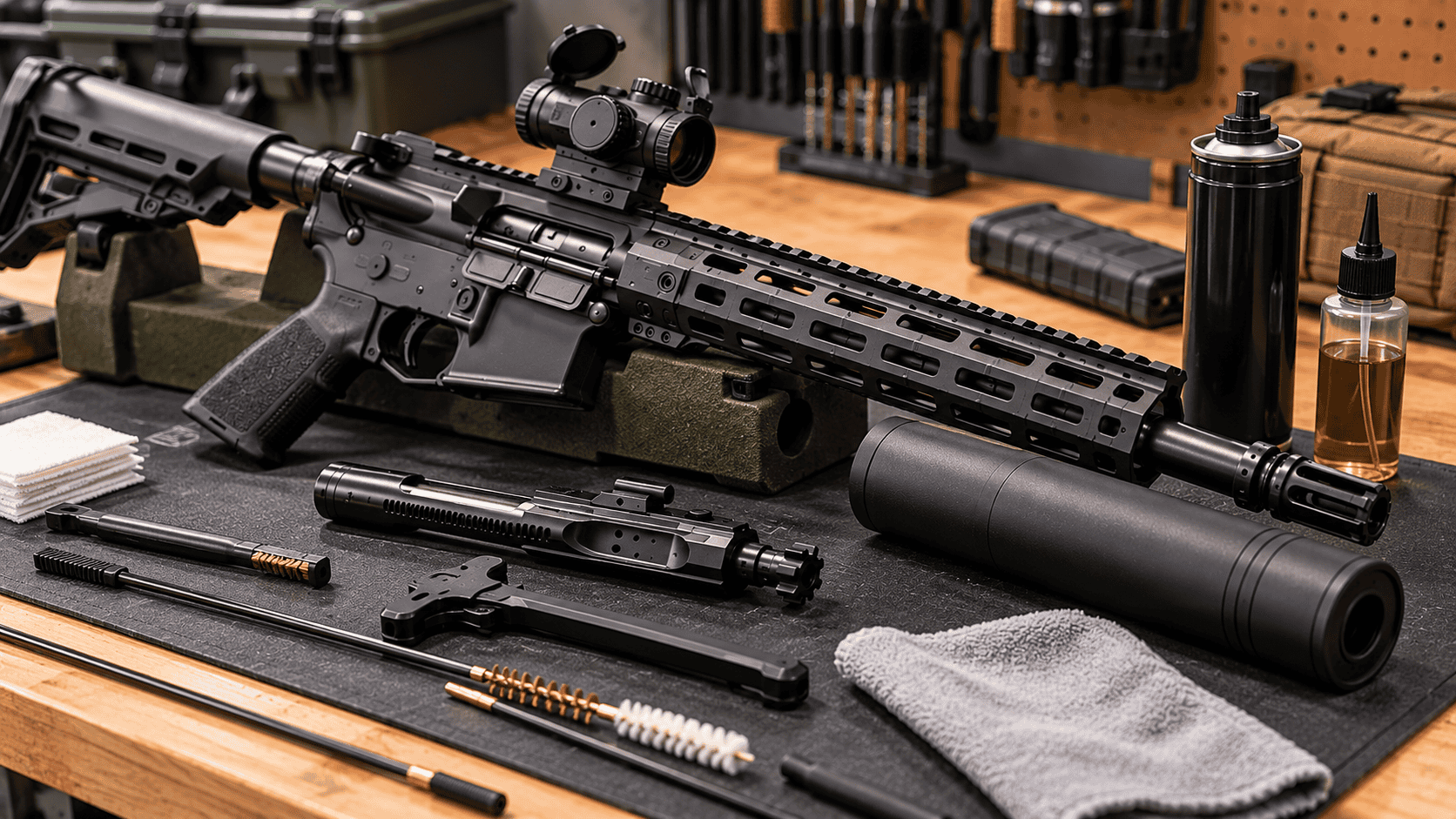
A competition rifle and a home-defense rifle are not the same tool, and
they should not share the same maintenance schedule. The competition gun runs
hard: multi-stage matches, high-volume training blocks, and rapid-fire strings
push carbon and heat through the bolt carrier group at a pace that demands
regular intervention. The defensive rifle sits in a safe or staged in a closet
for weeks at a time, accumulating dust, experiencing oil migration, and quietly
corroding in humid storage conditions. Both platforms will fail you if you
apply the wrong maintenance logic to them. Role determines maintenance.
The old military standard, which dictates cleaning after every range trip
without exception, was written for service rifles that see daily handling and
variable operational tempo. It is a functional baseline, but it does not
account for the specific failure modes that separate a competition shooter
chasing split times from a homeowner who needs their rifle to cycle on the
first trigger press after three months of storage. Matching your AR-15 cleaning
schedule to the rifle's actual role is the most direct path to reliable
performance in either context.
The Core Philosophy
of Role-Based AR-15 Maintenance
A single uniform cleaning interval fails both use cases. Role-based
maintenance acknowledges that different rifles accumulate different failure
risks at different rates, and that scrubbing a defensive rifle with the same
urgency as a match gun, or neglecting a match gun the way a stored defensive
rifle might be, introduces unnecessary risk in both directions.
For competition shooters, the dominant threat is mechanical. Fouling
slows the action. Carbon accumulates on the bolt tail, inside the carrier key,
and along the carrier rails with every round fired. Under high operational
loads, that fouling translates directly into sluggish cycling, increased bolt
carrier group friction, and eventual friction-induced failures during
rapid-fire strings when the action is already running hot. The competition
shooter's maintenance schedule is fundamentally a carbon management problem.
The defensive rifle presents an entirely different risk profile. Since it
rarely fires more than a few magazines between cleaning sessions, carbon
buildup is rarely the direct cause of failure. Instead, cold-start reliability
is the governing concern: the rifle must cycle flawlessly from a completely
static state, often after months of storage. The threats are environmental: oil
migration away from critical action points during long vertical storage, lint
and particulate accumulation inside the receiver, and moisture-induced surface
oxidation in humid storage environments. Addressing environmental degradation
requires a calendar-based inspection cadence, not a round-count trigger.
The Competition
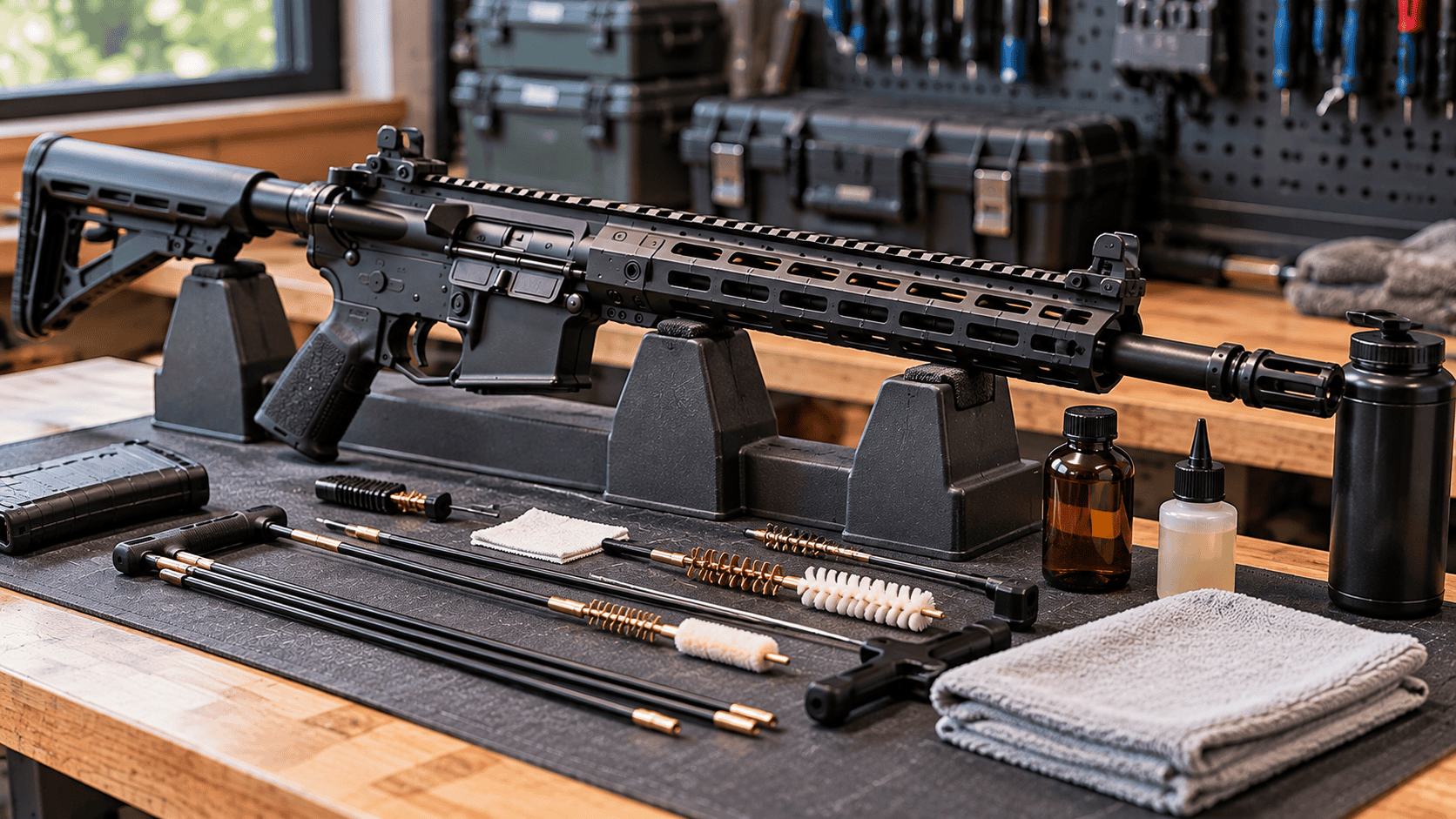
Rifle: High-Volume Performance Schedule
Match-grade performance erodes gradually, and the degradation is almost
always invisible until it isn't. Carbon fouling does not announce itself with a
malfunction; it builds quietly across hundreds of rounds, gradually slowing
bolt carrier travel, increasing the force required to strip a round from the
magazine, and eventually producing the kind of sluggish cycling that costs
fractions of a second per string. For a competitive shooter, those fractions
add up. Fractions cost matches. Mechanical efficiency is the metric that matters,
and maintaining it requires a preventative cleaning cadence rather than a
reactive one.
The core discipline is carbon management at the bolt carrier group and
chamber. Carbon accumulates fastest at the bolt tail, the gas key interior, and
the carrier rails, all of which are in direct contact with hot propellant gases
during every firing cycle. Letting that fouling compound across a full match
weekend without intervention is how a rifle that ran clean on Friday develops
cycling hesitation by Sunday afternoon. For shooters running rapid-fire strings
in timed stages, that hesitation is unacceptable.
- Cleaning Cadence: Clean the bolt carrier group and
chamber every 300 to 500 rounds to prevent carbon-induced sluggishness.
For multi-day matches, a field-expedient BCG wipe-down between stages is
worth the two minutes it takes.
- Bore Maintenance: Run a bore snake or cleaning rod
with non-abrasive solvent every 500 to 1,000 rounds to preserve
match-grade accuracy. Aggressive abrasive brushes used too frequently can
accelerate rifling wear, so match the tool to the fouling level.
- Lubrication Protocol: Apply a high-performance wet
lubricant to the bolt lugs, cam pin, and carrier rails before every match.
A dry BCG running at competition pace will generate friction at exactly
the wrong moment.
- Environmental Factors: Salina,
KS: Outdoor
matches in the Salina area introduce a specific hazard: high winds carry
agricultural dust and fine grit that mixes with heavy wet oils inside the
receiver to form an abrasive slurry. Shooters competing outdoors in
central Kansas during summer should consider lighter dry-film lubricants
or plan for more frequent cleaning intervals during dusty sessions. Heavy
grease that works well indoors becomes a liability when the wind is up.
The Home-Defense
Rifle: Absolute Reliability Schedule
A competition shooter who experiences a failure to feed loses a few seconds on the clock. A homeowner who experiences the same failure at 2 a.m. faces a profoundly different consequence. That asymmetry is why life safety governs every maintenance decision for a defensive rifle, and why the standard for defensive readiness is absolute rather than aspirational.
The defensive rifle's maintenance schedule is not about chasing peak
mechanical performance; it is about eliminating every avoidable failure mode
before it has a chance to manifest. That means accepting that operational risk
accumulates even when the rifle is not being fired. Dust settles into the
receiver. Lint migrates from storage bags and gun socks. Humidity cycles
through a safe in Salina's summer months, depositing microscopic moisture on
bare metal surfaces that were not wiped down recently enough. None of these
processes announce themselves, which is precisely why calendar-based inspection
is non-negotiable for a rifle kept in storage.
Surface rust is a particular concern for rifles stored in gun safes in
central Kansas. The humid summer climate creates conditions where even a rifle
stored indoors can develop light oxidation on the barrel exterior, receiver
surfaces, and bolt carrier group components if protective oil has dried out or
been absorbed by foam safe lining. Calendar-based maintenance, independent of
whether the rifle has been fired, is the only reliable countermeasure.
Quarterly inspections at minimum, with more frequent checks during the peak
humidity months of June through August, represent sound safe storage practice
for this environment.
- Monthly Inspection: Perform a visual inspection for
dust, lint, and rust. Wipe down the exterior with a light coat of
rust-preventative oil, paying attention to any bare metal surfaces that
contact the safe's foam lining, which can wick oil away from the finish
over time.
- Lubrication Migration: During extended vertical
storage, whether muzzle-up or muzzle-down, lubricants gradually migrate
away from critical action points due to gravity-induced runoff. The
specific rate and mechanical consequences of this migration vary with
lubricant viscosity and storage duration, but the practical implication is
clear: a rifle stored for several months without re-lubrication may have
dry friction surfaces even if it was properly oiled when it was last
staged. Quarterly re-lubrication addresses this.
- Quarterly Re-lubrication: Pull the BCG, wipe away old,
dust-laden oil, which by this point may carry enough particulate to act as
a mild abrasive, and apply a fresh, light coat of high-quality CLP to the
carrier rails, bolt lugs, and cam pin. Do not over-lubricate; excess oil
attracts additional dust and can migrate into the firing pin channel.
- Cold-Weather Advisory: For defensive rifles kept in
unheated spaces or vehicles during Kansas winters, heavy greases and
high-viscosity oils thicken significantly in freezing temperatures, which
can slow bolt carrier travel enough to cause cycling issues. Specialized
cold-weather lubricants rated for sub-freezing operation are the
appropriate choice for any rifle that might be called into use in a cold
environment.
"For a defensive tool, reliability is binary: it
either works or it doesn't. Carbon buildup from the range is predictable, but
safe dust and dry rails from months of neglect are silent points of
failure."
Critical Component
Breakdown: BCG, Chamber, and Gas System
The bolt carrier group is where maintenance decisions have the most
immediate mechanical consequence. It operates under the highest thermal load of
any component in the system, cycling through thousands of firing events while
accumulating carbon at the bolt tail, inside the gas key, and along the carrier
rails. Understanding the specific wear and fouling patterns at each location is
what separates a thorough cleaning from a superficial one.
Carbon fouling inside the gas key is highly significant because it
restricts gas flow, which directly affects the energy available to cycle the
action. A gas key that has not been scraped clean in several hundred rounds may
still function, but it is operating with a reduced gas impulse: a condition
that becomes a malfunction under any circumstance that further reduces cycling
energy, such as a slightly underpowered load or a suppressor-induced
backpressure change. The critical wear points on the BCG, including the bolt
lugs, the extractor claw, the cam pin bearing surface, and the gas rings, each
have distinct failure signatures that a disciplined inspection routine will
catch before they produce a stoppage.
The chamber deserves attention that it often does not receive. Chambers
must remain clear. Carbon deposits on the chamber walls, particularly at the
throat and just forward of the case head, can cause extraction difficulties by
increasing the friction between the fired case and the chamber surface. A
chamber brush with appropriate solvent removes this fouling efficiently;
neglecting it is one of the more common sources of hard extraction in rifles
that otherwise appear clean.
Step-by-Step AR-15
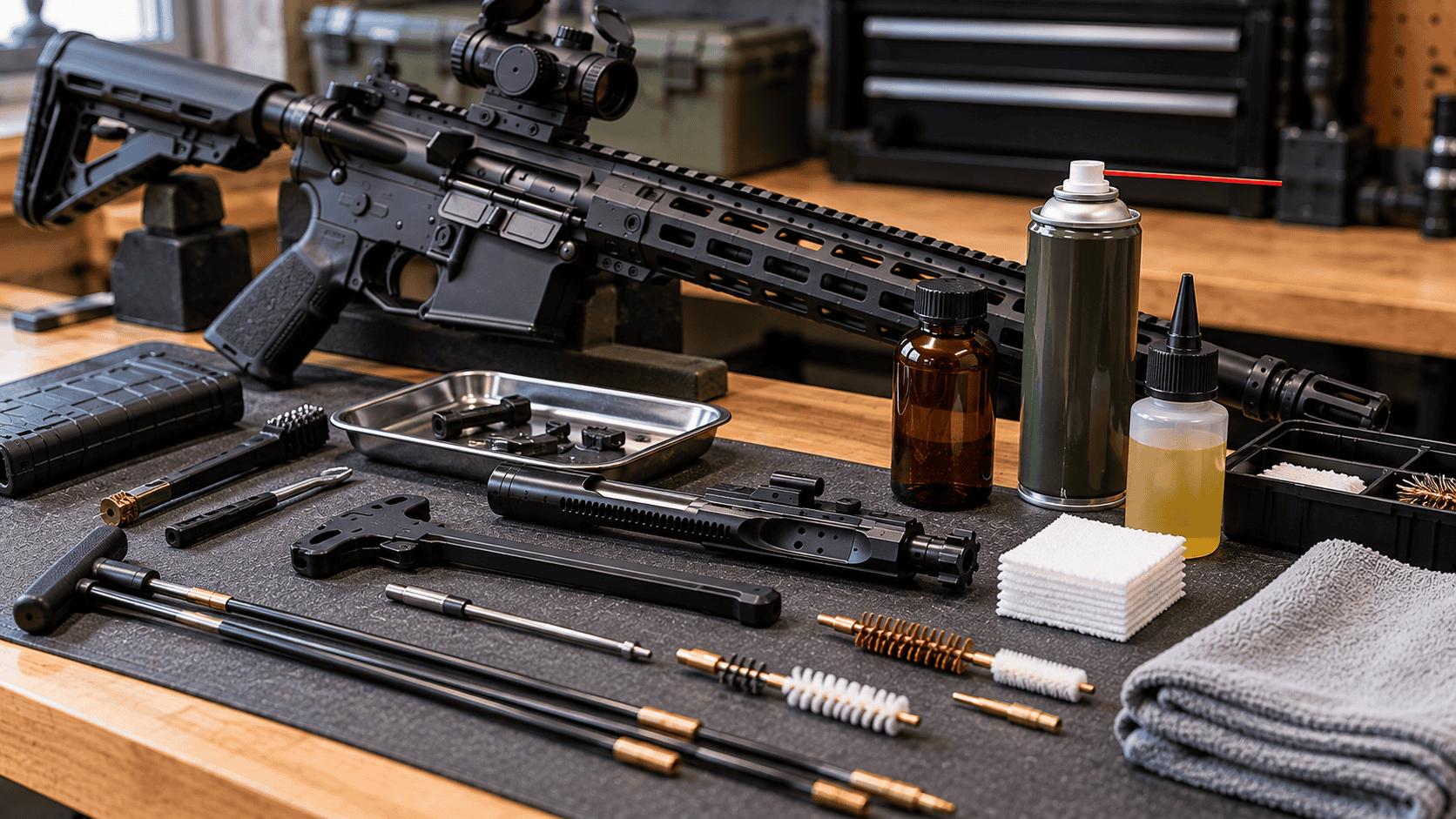
Reliability Inspection
A systematic inspection routine catches the failure modes that routine
cleaning misses. Cleaning removes fouling; inspection identifies wear, damage,
and mechanical degradation that cleaning cannot address. Running both as a
combined discipline, rather than treating inspection as an afterthought at the
end of a cleaning session, is what keeps a rifle fully duty-ready rather than
just visually clean.
- Visual Inspection: Check the gas key for tightness
and confirm that the staking is intact and has not cracked or migrated.
Inspect the extractor claw for chipping or rounding, and compress the
extractor spring to verify it retains adequate tension. A weak extractor
spring is one of the most common causes of failures to extract in
high-round-count rifles.
- Gas Ring Condition: Worn gas rings produce sluggish
cycling and, in advanced cases, failures to unlock. If you suspect gas
ring degradation based on cycling behavior, consult a certified armorer
for a proper assessment rather than attempting to diagnose ring wear
without the appropriate tools and reference standards.
- Castle Nut and Barrel Nut: Verify that the castle nut is
properly staked and that the barrel nut is secure. Do not attempt to
assign torque values to these components without referencing your specific
manufacturer's specifications; torque requirements vary by barrel nut
design and upper receiver material, and fabricating a number here creates
more risk than it resolves.
- Dry Function Check: Perform a dry function check to
verify that the safety selector, trigger, and trigger reset are all
functioning correctly. Follow the safety protocols and specific sequence
outlined in your manufacturer's manual; the steps vary enough between
manufacturers that a generic sequence could mask a real mechanical issue.
Maintaining an AR-15 does not require complex gunsmithing tools for
routine care. What it requires is discipline: the discipline to separate your
rifles by their operational roles and apply the maintenance logic that each
role demands. A competition gun that gets cleaned on a round-count schedule
runs faster and more consistently. Speed requires cleanliness. A defensive gun
that gets inspected on a calendar schedule eliminates the silent failure modes
that storage introduces. Neither approach is complicated, but conflating the
two is how rifles fail at the worst possible moment.
Frequently Asked
Questions About AR-15 Maintenance
How often should an
AR-15 be cleaned?
Generally, an AR-15 should be cleaned after every high-volume training
session, roughly every 300 to 500 rounds, to maintain peak mechanical
performance. For rifles kept in storage for home defense, quarterly cleaning
and inspection is the minimum cadence to mitigate environmental dust
accumulation and oil migration, even if the rifle has not been fired since the
last service.
How many rounds can
an AR-15 fire before cleaning?
Many quality AR-15 platforms can function for 500 to 1,000 rounds without
a stoppage under favorable conditions. That said, cleaning the bolt carrier
group every 300 to 500 rounds is the more sound practice for competition use,
because carbon buildup degrades cycling speed and feed reliability
incrementally, and the degradation is rarely obvious until it produces a
malfunction during a timed string.
How do I clean my
AR-15 for the first time?
Ensure the weapon is completely clear and unloaded before handling any
components. Verify the chamber is empty. Field-strip the rifle by separating
the upper and lower receivers, then remove the bolt carrier group and charging
handle. Use dedicated solvents and nylon brushes to clean the bore, chamber,
and BCG components; carbon scrapers are appropriate for the bolt tail and gas
key interior. Once all fouling is removed, apply a light coat of CLP to the
friction points on the BCG, reassemble, and perform a function check per your
manufacturer's manual.
What are the key
areas that must be oiled on an AR-15?
Lubrication belongs on the high-friction surfaces of the bolt carrier
group: the carrier rails, the bolt lugs, the cam pin, and the exterior of the
bolt body. The interface between the charging handle and the upper receiver
benefits from a light wipe as well. Avoid over-lubricating the firing pin
channel or the interior of the buffer tube; excess oil in those areas attracts
particulate and can cause reliability issues rather than preventing them.
What is the typical
operational lifespan of critical AR-15 components?
A quality barrel generally maintains match-grade accuracy for somewhere
between 6,000 and 15,000 rounds, with the actual figure depending heavily on
firing cadence, barrel steel composition, and whether the rifle is shot
suppressed. Bolt assemblies, extractor springs, and gas rings should be treated
as wear components and inspected regularly; replacing them as preventative
maintenance within similar round-count intervals is more reliable than waiting
for a failure to prompt the swap. Maintaining your AR-15 according to its
specific intended role is the single most effective way to guarantee
performance when it matters most. Do not neglect maintenance. Whether you are
shaving seconds off your stage times in a local competition or keeping a
defensive rifle staged and ready in Salina, matching your cleaning schedule to
your environment and use case ensures your platform remains duty-ready under
any conditions. For specialized technical support or professional armorer
services, contact our team through the Contact Us portal today.


