
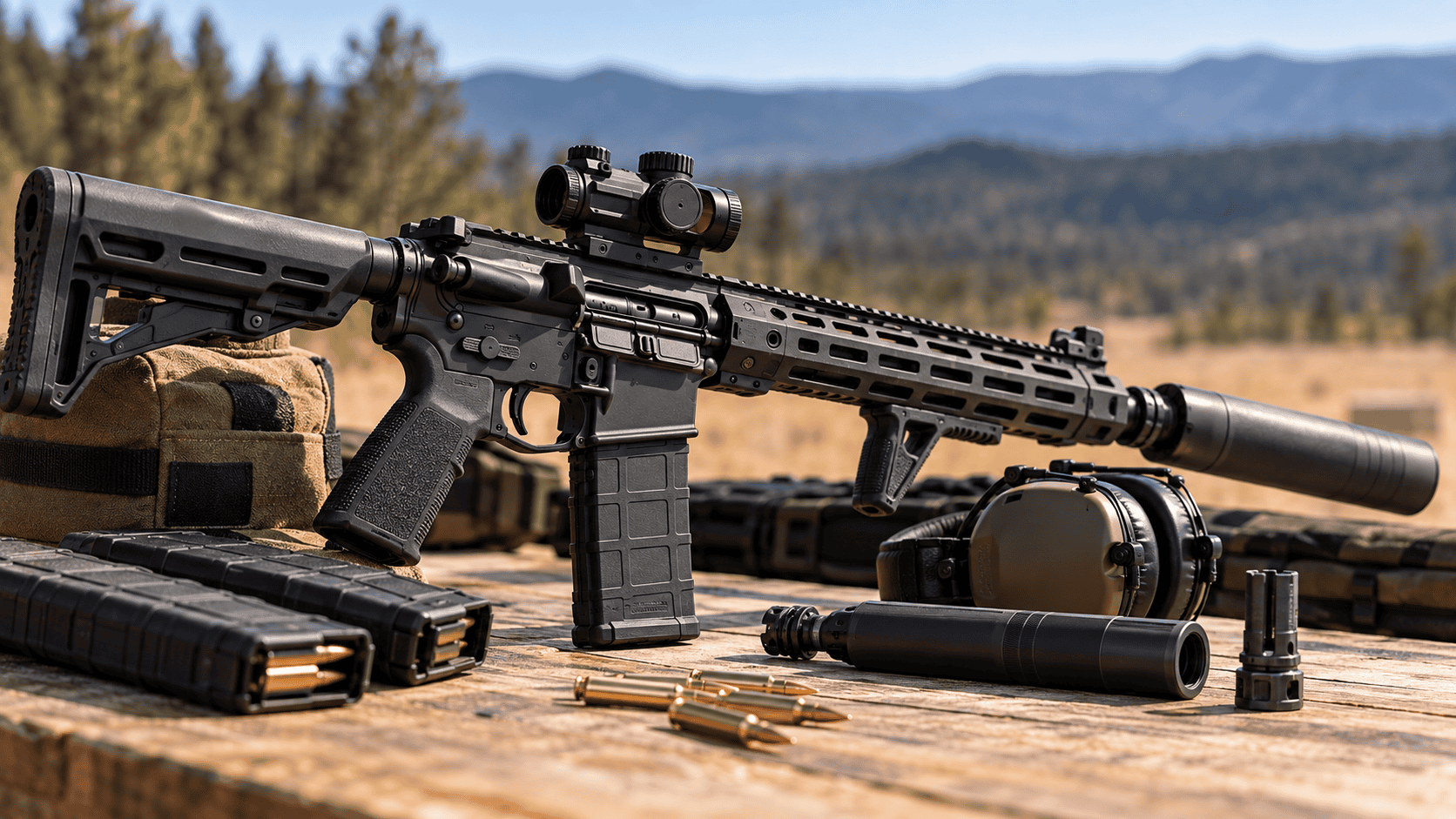
Mounting a suppressor to an unmodified AR-15 does not just change the
sound signature; it fundamentally disrupts the rifle's operating cycle. The
suppressor traps expanding gases at the muzzle, and a significant portion of
that trapped volume reverses course down the barrel and gas tube, arriving at
the bolt carrier group with far more energy than the system was designed to
absorb. The result is mechanical failure: premature bolt unlocking while
the case is still expanded against the chamber walls, violent extraction that
tears rims and batters the ejector, and carbon-laden gas venting directly into
the shooter's face through the charging handle and upper receiver.
A threaded barrel is the starting point, not the solution. It is not
enough. Builders who stop there end up with a rifle that runs brutally
over-gassed, throws brass at 1 to 2 o'clock, and accelerates wear on the bolt
lugs, cam pin, and buffer components at a rate that would be unacceptable in
any duty context. Achieving genuine suppressor readiness means engineering the
entire gas and reciprocating-mass system to handle the elevated pressure
environment that a silencer creates.
The Mechanical
Reality of a Suppressor-Ready AR-15 Build
A suppressor functions by providing a series of expansion chambers that
slow and cool propellant gases before they exit the muzzle, reducing the
acoustic signature of the shot. The tradeoff is that those same gases, now
partially trapped, exert pressure back through the barrel's gas port and into
the gas tube at a volume and velocity that exceed what a standard AR-15 gas
system was calibrated to manage. When that over-pressured gas reaches the bolt
carrier, it drives the carrier rearward before chamber pressure drops to a safe
extraction threshold. The bolt unlocks early, the case is still gripping the
chamber walls under residual pressure, and the extractor tears across the rim.
This destroys parts. Over thousands of rounds, the bolt lugs and cam pin absorb
the mechanical abuse of this accelerated cycle and wear accordingly.
The engineering goal of a suppressor-ready build is to intercept this
pressure imbalance before it reaches the action and to slow the bolt
carrier's rearward travel enough to restore the rifle's original dwell-time
relationship. Three areas of the rifle govern this: the gas regulation
system, the reciprocating mass of the buffer assembly, and the mechanical
security and concentricity of the muzzle interface. Neglecting any one of them
produces an unbalanced system: one that may short-stroke when fouled or batter
its own components under rapid fire.
Managing Gas
Dynamics and Suppressor Backpressure
Controlling gas at the source is the most critical intervention in a suppressed build. Excess gas
causes problems. A standard, fixed-orifice gas block delivers a set volume of
gas to the carrier regardless of operating conditions, and those conditions
change substantially when a suppressor is attached. The excess gas that enters
the receiver manifests as erratic ejection patterns, typically throwing spent
brass forward toward the 1 to 2 o'clock position, and as the "gas
face" phenomenon where carbon-laden gas vents through the charging handle
gap and into the shooter's eyes and mouth. Restricting gas flow before it
enters the gas tube addresses both problems simultaneously and reduces the
downstream mechanical stress on every component in the action.
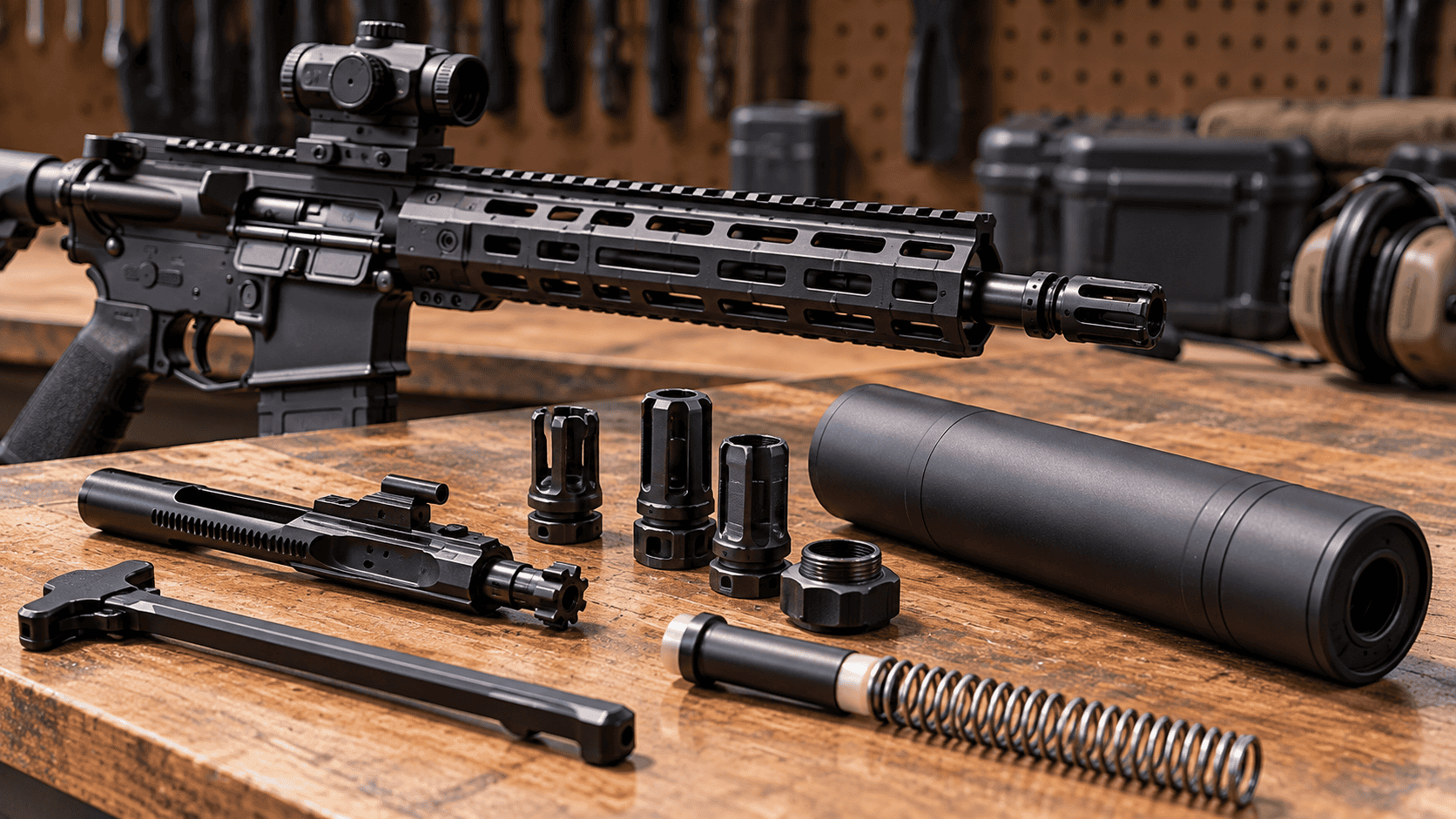
Three components work together to manage this:
- Adjustable Gas Block: A click-adjustable gas block
allows the shooter to methodically restrict gas flow in measured
increments until the rifle achieves reliable bolt lockback on an empty
magazine. Starting from a fully open position and closing the port
incrementally under live-fire conditions, the builder can dial in the
minimum gas volume required for reliable function, eliminating the excess
that drives over-gassing without sacrificing the margin needed for
reliable cycling when the rifle is dirty or cold.
- Gas-Defeating Charging Handle: Standard charging handles vent
escaping gas directly into the shooter's face through the gap between the
handle body and the upper receiver. Charging handles designed with
integrated gas seals or lateral vent ports redirect this blowback away
from the shooter, addressing the ergonomic and safety hazard of sustained
suppressed fire without requiring any changes to the gas system itself.
- Enhanced Bolt Carrier Group: Carrier groups engineered for
suppressed use often incorporate altered gas port geometry or additional
venting channels that allow excess pressure to exhaust through the
ejection port rather than driving the carrier rearward with full force.
This reduces the peak velocity of the carrier's rearward stroke and
complements the adjustable gas block's upstream restriction.
Selecting the Right
Muzzle Interface and Barrel Profile
Barrel profile matters more in a suppressed build than most builders anticipate. A lightweight or pencil-profile barrel flexes under the cantilevered weight of a muzzle-mounted suppressor, and that flex translates directly into point-of-impact shift; this shift can be significant enough to move rounds off a precision target at distance. A government or heavier profile provides the rigidity needed to support the suppressor's mass without introducing harmonic instability that degrades accuracy. Beyond profile, the gas port diameter must be appropriate for suppressed operation; a port sized for unsuppressed use will admit even more gas under the elevated backpressure of a silencer. The exact diameter specifications vary by barrel length, caliber, and gas system length and should be verified against the barrel manufacturer's suppressor-use guidance rather than assumed from general figures.
Thread concentricity is the other non-negotiable on the barrel end. Alignment is critical.
The suppressor's baffle stack extends several inches forward of the muzzle, and
any angular deviation between the bore axis and the thread axis compounds over
that distance. Threads must be cut perpendicular to the bore, and the muzzle
face must be cut square to the bore axis, ensuring the muzzle device seats
flush against the barrel shoulder with zero angular offset. The specific thread
pitch required depends on the caliber and the suppressor manufacturer's specifications;
builders must verify compatibility between the barrel's thread specification
and the muzzle device before mounting anything. Assuming compatibility between
components from different manufacturers without that verification is how baffle
strikes happen.
Muzzle attachment methods each carry distinct trade-offs:
- Direct-Thread Mounts: Direct-threading the suppressor
onto the barrel simplifies the system and eliminates the weight and
complexity of a dedicated muzzle device. The practical limitation is
thermal expansion: as the barrel and suppressor heat up under sustained
fire, the suppressor can back off the threads. Regular torque checks and
the use of a thread-locking compound rated for high-temperature
applications are essential with this approach.
- Quick-Detach (QD) Muzzle Devices: A QD flash hider or muzzle brake
provides a repeatable, indexed mounting interface that locks the
suppressor in place and resists backing off under heat. The muzzle device
also functions as a sacrificial first baffle, absorbing the initial blast
of erosive gases before they reach the suppressor's internal baffles,
which meaningfully extends suppressor service life.
- Pinned and Welded Setups: Pinning and welding a muzzle
device to the barrel is a common approach for builds using shorter
barrels, where the device's length contributes to meeting federal minimum
overall length requirements. The specific length thresholds and how a
pinned/welded device factors into those measurements are governed by
federal statute and should be confirmed with a licensed attorney or
qualified FFL before any metal is cut, as the regulatory details are not
something to reconstruct from general knowledge.
Balancing
Reciprocating Mass with Buffer Systems
Even with an adjustable gas block dialed in, the bolt carrier group's
rearward velocity under suppressed conditions will likely exceed what a
standard carbine buffer can adequately slow. The buffer's job in this context
is to delay bolt unlocking long enough for chamber pressure to drop
before the case begins to move. A heavier buffer increases the inertia the gas
pressure must overcome to initiate rearward travel, and a stiffer buffer spring
adds a progressive resistance force that further slows the carrier's stroke.
Together, they restore the dwell-time relationship that the suppressor's added
backpressure disrupted. This protects the action.
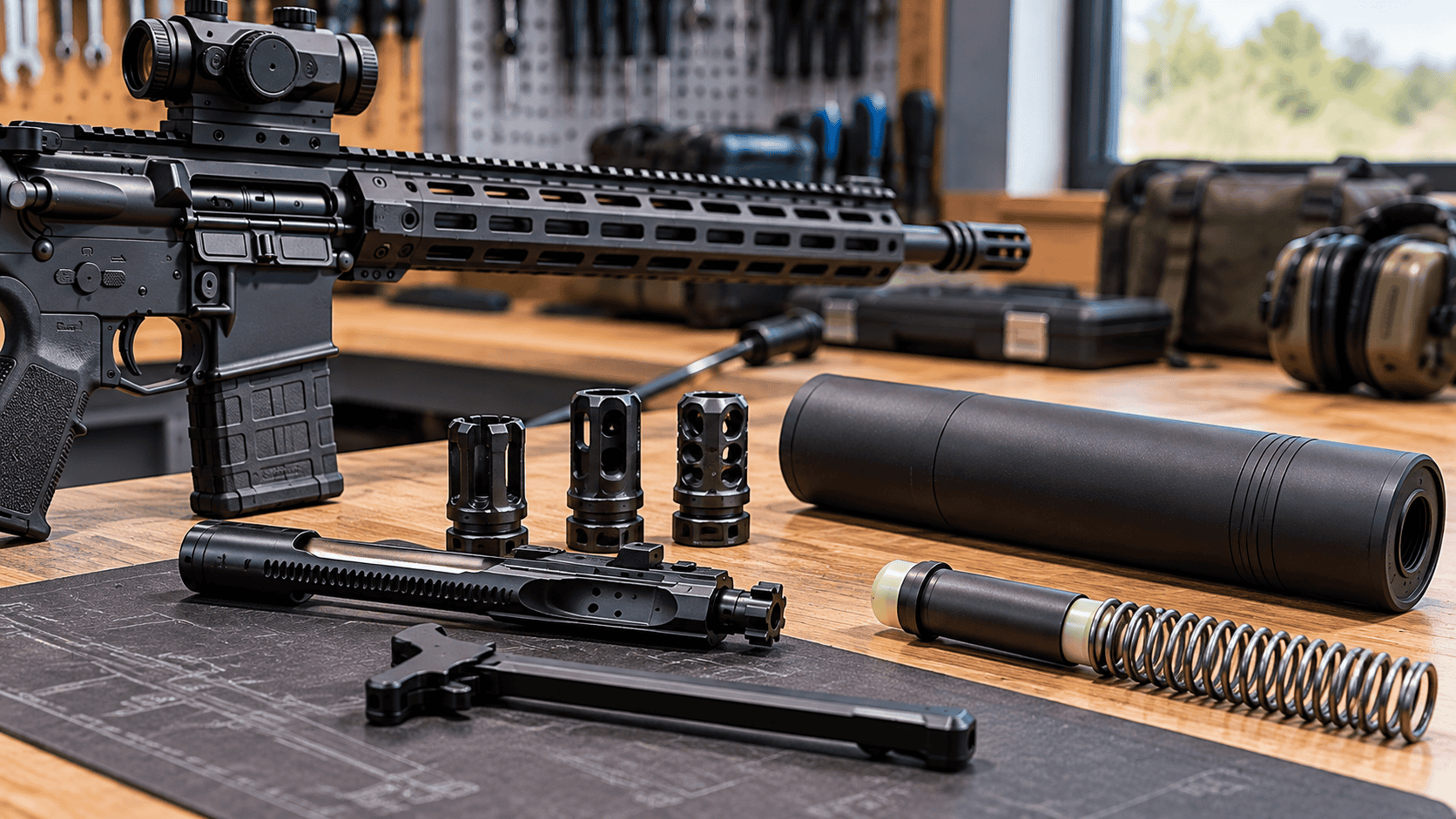
H2 and H3 heavy buffers accomplish this through the addition of tungsten weights to the buffer
body: tungsten's density allows meaningful mass increases without requiring a
longer buffer that would interfere with the buffer tube geometry. The H3
configuration carries the most tungsten weight of the standard heavy buffer
lineup and is typically the starting point for short-barreled suppressed builds
where dwell time is already compressed by the shorter gas system. Whether an H2
or H3 is appropriate for a given configuration depends on the barrel length,
gas system length, and how aggressively the gas block has been restricted; the
two adjustments work in tandem and should be tuned together rather than in
isolation.
Navigating the
Legal and Regulatory Landscape for Suppressed Builds
The mechanical build is only half the picture. Federal laws apply.
Suppressors occupy a tightly regulated category under federal law, and the
compliance requirements for acquiring or building one are distinct from those
governing the host rifle.
- National Firearms Act (NFA) of
1934: Under the NFA, firearm silencers and mufflers are legally
classified as firearms subject to strict registration and a $200 tax on
both the making and transfer of each item, a tax rate that has remained
unchanged since the Act's passage, per the Bureau of Alcohol, Tobacco, Firearms and
Explosives. The original legislative intent was to curtail transactions in
these items through a prohibitively expensive tax; the $200 figure was
chosen in 1934 when it represented a significant financial barrier, though
it has never been adjusted for inflation in the decades since.
- Firearm Owners' Protection Act of
1986: This act expanded the legal definition of a silencer to cover not
just complete devices but any combination of parts designed for
fabricating or assembling a silencer, as well as any individual part
intended solely for that purpose. The practical implication for builders
is that acquiring certain components, even without a complete suppressor
in hand, can trigger NFA classification and registration requirements
under the Bureau of Alcohol, Tobacco, Firearms and Explosives.
- Privately Made Firearms (PMFs): Builders assembling a
suppressor-ready AR-15 as a privately made firearm face additional
tracking requirements. Federal regulations require Federal Firearms
Licensees (FFLs) to record any PMF taken into inventory on the revised ATF Form 4473, and unless the firearm is
already marked, the FFL must apply an individual serial number prefix
based on their abbreviated license number before the transaction can
proceed.
For builders in Salina, Saline County, Kansas, the regulatory picture
shifted materially following the passage of the One Big Beautiful Bill Act
(OBBA). Congress's elimination of the federal tax on suppressors and
short-barreled firearms through the OBBA prompted a federal district court in
the Northern District of Texas to enjoin the ATF from enforcing NFA
registration, reporting, and recordkeeping requirements for those items against
Kansas gun owners, as detailed by the Kansas Attorney
General's Office. The court's reasoning was direct: without the tax, Congress loses the
constitutional tax-power basis that historically justified NFA registration
mandates, meaning Kansas residents can currently acquire suppressors without
the previously required federal registration process. That said, the injunction
remains subject to federal appeals and broader national litigation. The legal
landscape here is genuinely unsettled, and builders in Kansas should monitor
developments through the Kansas Attorney General's Office rather than treating
the current injunction as a permanent resolution.
Frequently Asked
Questions About Suppressed AR-15 Builds
Why does my AR-15
experience failure to extract when shooting suppressed?
This is typically caused by excessive bolt velocity. The increased
backpressure from the suppressor unlocks the bolt too early while the cartridge
casing is still expanded against the chamber walls. Upgrading to a heavier
buffer (such as an H2 or H3) and a stronger extractor spring can delay
unlocking and ensure reliable extraction.
Do I need an
adjustable gas block if I run a flow-through suppressor?
Flow-through or low-backpressure suppressors are engineered to vent gases
forward, significantly reducing the amount of gas redirected back into the
action. While an adjustable gas block may not be strictly necessary for these
systems, it is still highly recommended to fine-tune the rifle for optimal felt
recoil and parts longevity.
How does a
suppressor affect the point of impact (POI) of my rifle?
Adding a suppressor changes the barrel's weight distribution and
harmonics, which naturally shifts the point of impact. A heavy barrel profile
minimizes this shift. As long as the muzzle device is concentric and the
suppressor is mounted securely, the POI shift should be consistent and
repeatable.
Can I use standard
gun oil on a suppressed AR-15 build?
Suppressed firearms run significantly dirtier and hotter due to trapped
carbon and gas. Standard light gun oils will burn off rapidly under these
conditions. It is highly recommended to use a high-temperature, duty-ready
synthetic lubricant or grease that resists carbon fouling and maintains its
viscosity under extreme heat.
Is a muzzle brake
or a flash hider better for mounting a suppressor?
A muzzle brake is generally preferred for dedicated suppressed builds
because its internal baffles act as a "sacrificial blast shield,"
redirecting high-pressure gases and unburnt powder before they reach the
suppressor's first baffle. This significantly extends the suppressor's service
life.
Contact Us Today
Building a suppressor-ready AR-15 requires treating the rifle as a
complete, pressure-regulated system rather than a collection of independent
parts. By managing gas dynamics at the block, balancing the reciprocating mass
with the correct buffer assembly, and ensuring precise muzzle alignment, you
can eliminate harsh blowback and premature wear. Take the next step in planning
your build by consulting with a qualified armorer or selecting duty-ready
components engineered specifically to withstand the increased thermal and
mechanical stresses of suppressed operation.
Whether you need assistance, have a question, or want to share feedback,
our Contact Us portal is the best way to reach us. You can
also use it to let us know if a product or any part of your shopping experience
did not meet your expectations. We do our best to respond promptly, but please
allow a few days for our team to review, research, and respond to your inquiry.


