
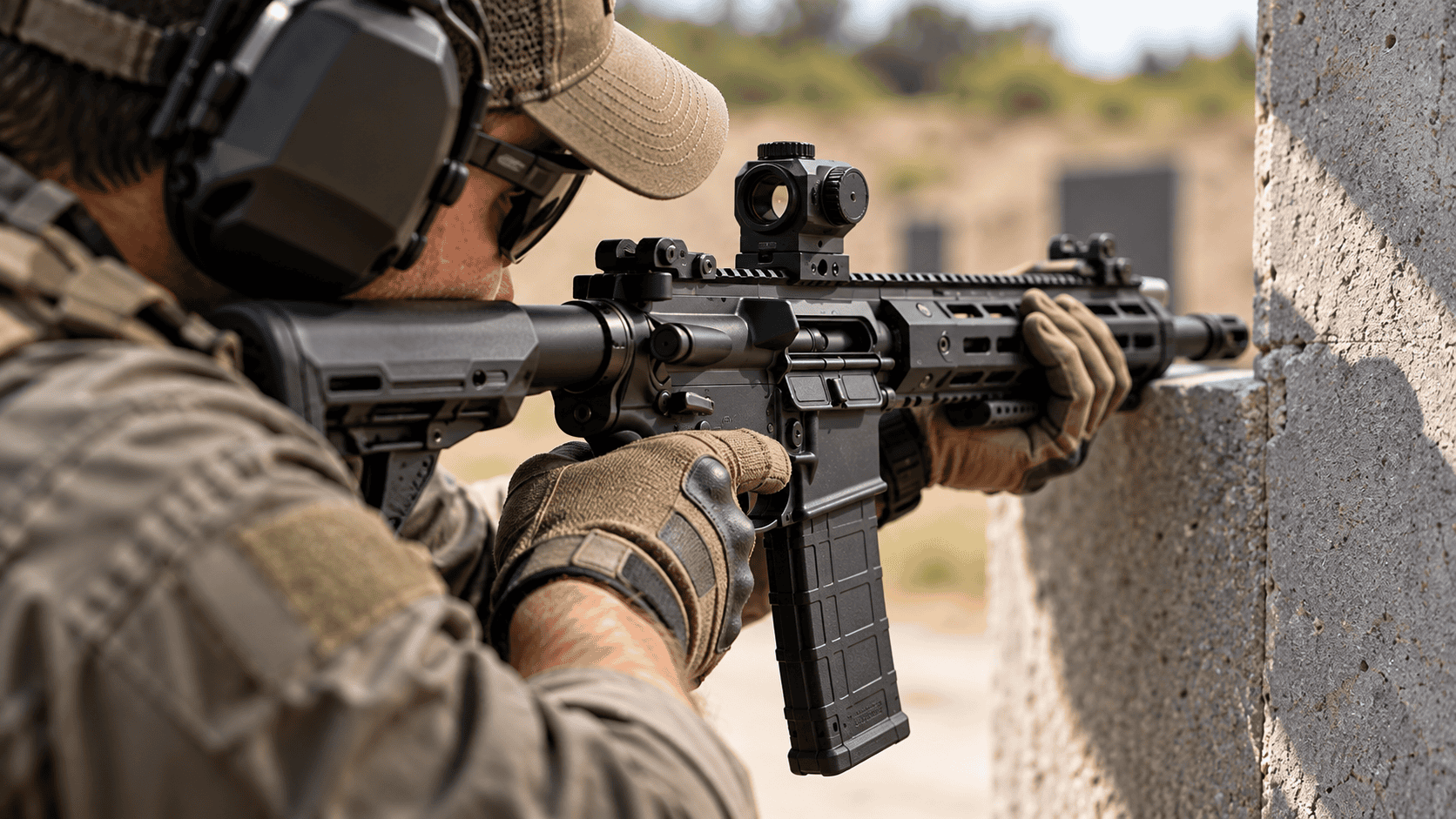
When a barricade forces a sudden shoulder transition, a right-hand-only
safety selector becomes an immediate operational bottleneck. Seconds lost cost
lives. Fumbling to disengage a single-sided control with your support thumb
costs split-time you cannot recover, and transitioning to the left shoulder
should not require breaking your master grip or contorting your hand around the
receiver.
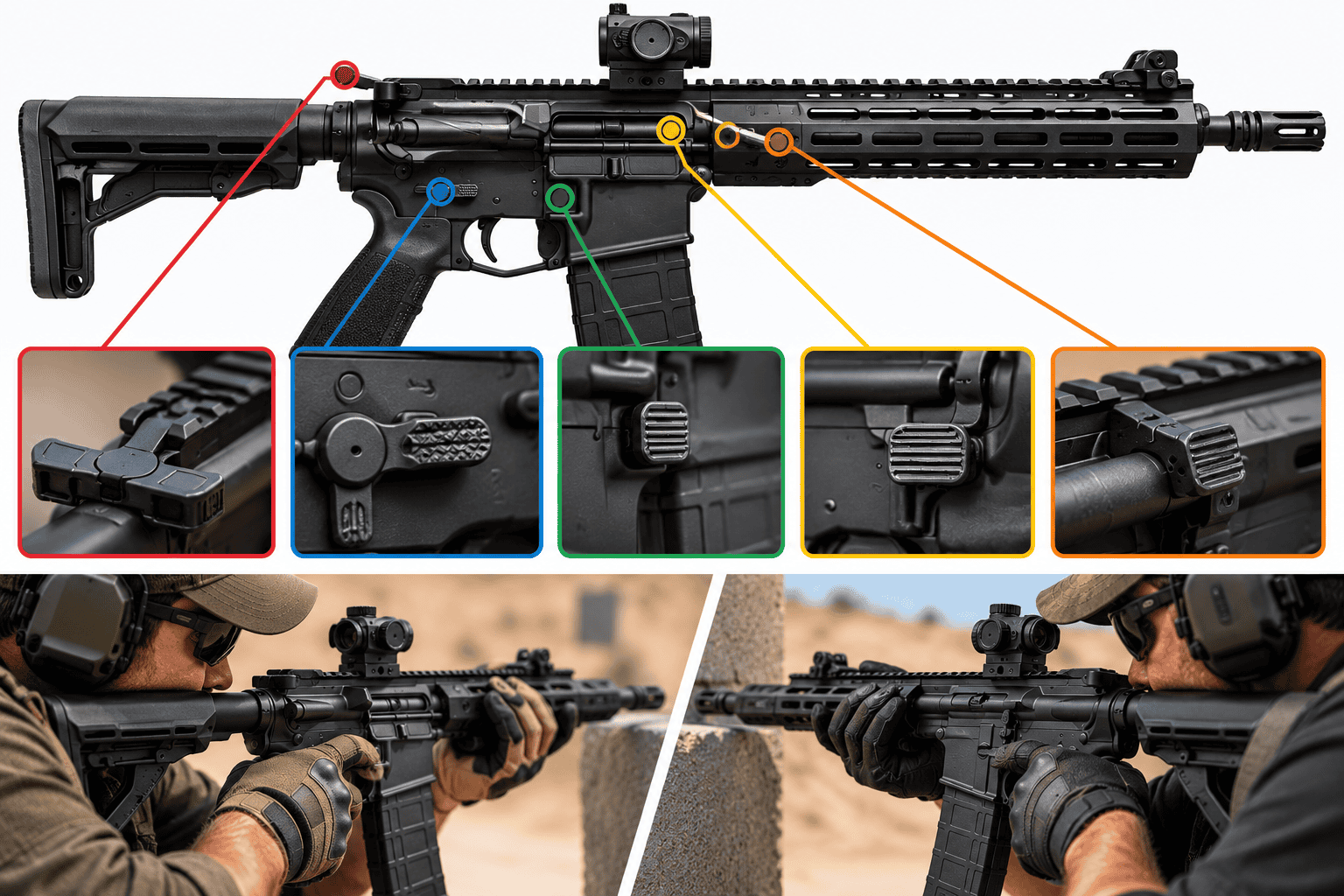
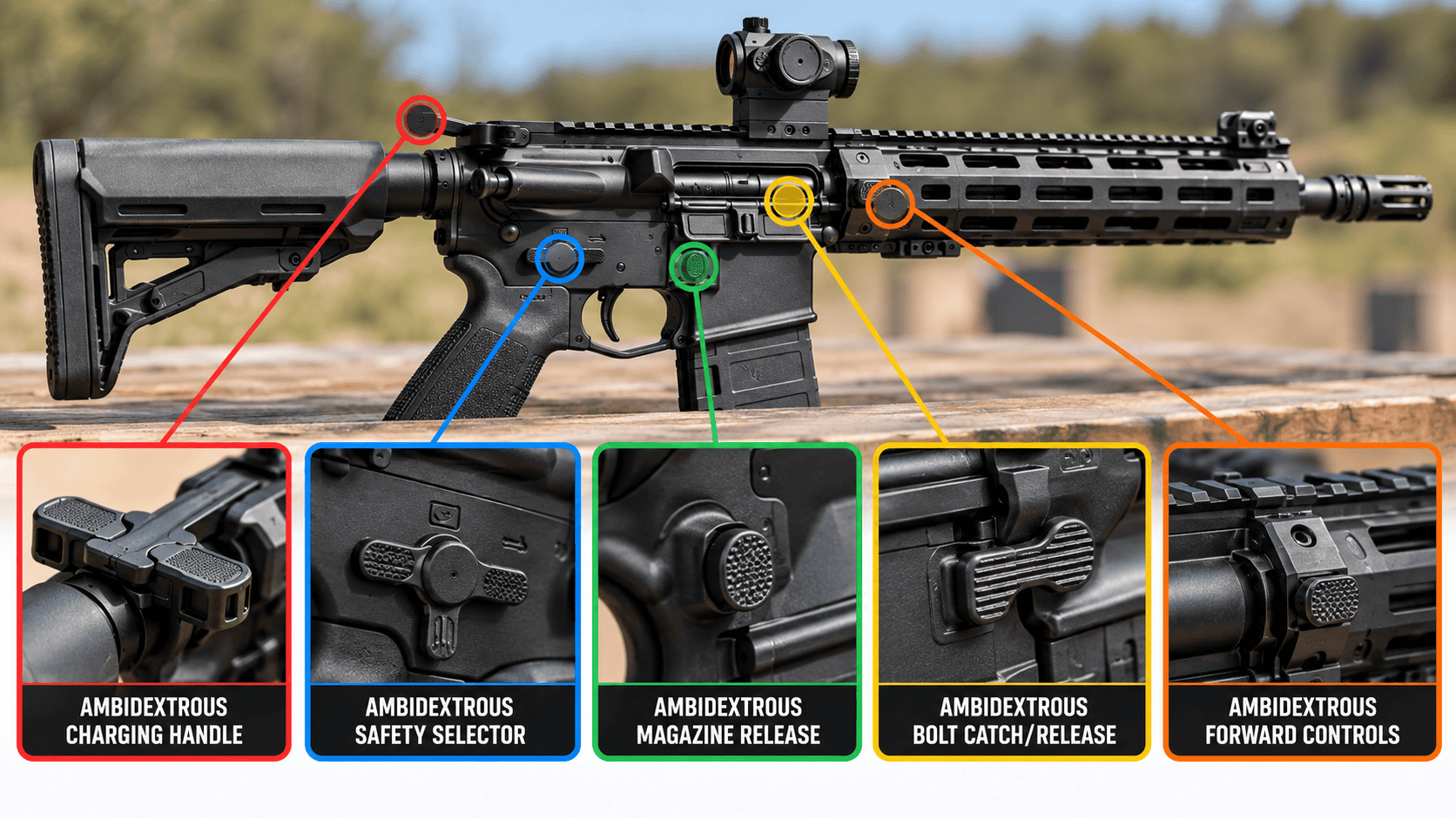
Ambidextrous AR-15 controls address this directly. The three primary
modifications, the safety selector, the charging handle, and the magazine
release, convert a standard mil-spec lower into a platform that responds
equally well from either shoulder or either hand. For left-handed shooters,
these components are the difference between a rifle that fights their natural
mechanics and one that works with them. For right-handed competitive shooters,
they eliminate the single-hand dependency that slows down malfunction
clearances and support-side drills. Each component solves a specific
manipulation bottleneck, and each carries its own mechanical trade-offs worth
understanding before you commit to a build direction.
- Enables direct shoulder
transitions around cover without breaking the master grip or repositioning
the firing hand
- Allows rapid one-handed
malfunction clearances, locking the bolt to the rear while maintaining
weapon control, from either side of the receiver
- Provides full ergonomic access
for left-handed shooters on a standard mil-spec lower without requiring a
dedicated left-hand receiver
- Reduces split times during timed
competitive reloads by placing the magazine release within natural thumb
reach on both sides
The Operational
Necessity of Ambidextrous Rifle Manipulation
Contemporary shooting doctrine does not assume a single firing position.
Instructors teaching barrier work, vehicle drills, and close-quarters movement
have standardized shoulder transitions as a core skill, not an advanced
one. When your rifle's controls only function from the right side, every
transition to the left shoulder creates a decision point: reach across the
receiver with your right hand, shift your grip, or accept degraded manipulation
capability on the support side. None of those options hold up when the clock is
running or the situation is dynamic. Hesitation invites failure. A
well-configured ambidextrous control set removes the decision entirely. Think
of it the way a duty belt distributes weight and access across the entire frame
rather than concentrating everything on one hip: the goal is to eliminate
single-point failure from your weapon's ergonomic design.
Right-handed shooters often dismiss ambidextrous controls as a
left-handed accommodation, but that argument misses where the operational
utility sits. One-handed malfunction clearances are the clearest
example. Locking the bolt to the rear during a double-feed requires the shooter
to hold the weapon with one hand while manipulating the charging handle and
bolt release with the other. If the bolt release only activates from the left
side of the receiver, a right-handed shooter working with their support hand is
at a mechanical disadvantage. The same logic applies to off-hand shooting
during sustained rapid fire, where the firing hand may be occupied or injured.
These controls are tested for sustained rapid fire and won't fail under
operational load. Ambidextrous controls remove arbitrary limitations from the
platform, limitations that exist because of manufacturing convention, not
because they serve the shooter.
Ambidextrous Safety
Selectors and Throw Angles
- Short-throw selectors reduce the arc from safe to
fire, moving through roughly half the travel of a standard 90-degree
throw, allowing the shooter to disengage the safety with a flick of the
thumb and re-engage it with the index finger from the opposite side
without repositioning the firing grip. The reduced arc also means less
thumb travel during rapid-fire strings, which compounds across a full
stage.
- Modular lever configurations let the shooter choose between
standard-length, short, or thin levers on each side independently, which
prevents the left-side lever from contacting the trigger finger during the
firing grip. This is not a minor ergonomic preference: an improperly sized
left lever will drag against the trigger finger and alter your pull weight
perception under stress.
- CNC-machined steel or aluminum
levers with positive detent engagement provide the tactile feedback that
confirms the selector has fully seated in the fire or safe position. When
operating with gloves or in low-light conditions, that audible and tactile
click is the only reliable confirmation available.
- Mil-spec compatibility is a
minimum threshold. It is not a marketing differentiator. Any ambidextrous
safety selector worth installing drops into a standard AR-15 lower without
requiring receiver modification, custom fitting, or permanent alteration
to the selector channel.
Ambidextrous
Charging Handles for High-Stress Clearing
The charging handle is often the first ambidextrous upgrade shooters
make, partly because installation requires no tools and no permanent
modification, and partly because the operational benefit is immediately obvious
during any malfunction drill. The mil-spec single-latch design was engineered
for simplicity, not for speed or versatility: a dual-latch ambidextrous
replacement addresses both gaps without changing anything else about the upper
receiver.
- Dual-latch designs allow the shooter to rack the
bolt carrier from either side using a single finger, a pinch grip, or a
palm blade, whichever the situation permits. During vehicle egress, when
one arm may be braced against a door frame or seat, the ability to rack
from either side without repositioning is a verifiable operational
advantage.
- Extended or textured latch
surfaces provide positive purchase when operating with heavy gloves in cold
weather or when the handle is wet from rain or perspiration. A standard
mil-spec latch offers minimal contact area; an ambidextrous extended latch
multiplies available grip surface significantly, which matters when
dexterity is compromised.
- Reduced carrier tilt is a secondary benefit of
symmetrical latch engagement. When both latches bear load simultaneously
during a hard rack, the handle pulls straight rearward rather than
canting, which reduces wear on the upper receiver's charging handle
channel across thousands of cycles.
- Drop-in installation means no
permanent modification to the upper receiver. The charging handle is a
direct replacement for the mil-spec part, making it the pragmatic initial
step in any ambidextrous upgrade sequence, offering low commitment and
immediate return.
Ambidextrous
Magazine Releases and the Accidental Drop Debate
The concern about accidental magazine drops is legitimate and
worth addressing directly. Unintended drops disable your weapon. A slung rifle
pressing against body armor, a plate carrier, or the side of a vehicle can
generate enough lateral pressure on an extended magazine release button to
actuate it, particularly on designs that prioritize ease of reach over
deliberate activation. Shooters who carry their rifle slung muzzle-down or who
work in confined spaces where the receiver contacts surfaces regularly have
documented unintended magazine drops with certain extended-button designs. This
is a real failure mode, and any honest evaluation of ambidextrous magazine
releases has to account for it before recommending a specific approach.
The engineering solution to this problem has produced several distinct
design philosophies. Shielded releases, where the left-side button sits
recessed within a raised guard, require the shooter to apply deliberate inward
pressure rather than incidental contact. Tension-optimized designs increase the
spring force required to actuate the catch, so the button resists casual
contact but yields cleanly under intentional thumb pressure. The Norgon
Ambi-Catch takes a different approach: it replaces the standard magazine
catch with an integrated ambidextrous mechanism that uses the same spring
tension as the mil-spec part, keeping the activation threshold consistent with
what right-handed shooters already expect from their rifle. The Forward
Controls Design EMR-A and similar low-profile options extend the right-side
button slightly rather than adding a full left-side paddle, reducing the
overall footprint while still providing left-hand access. Each approach involves
an inherent trade-off between accessibility and accidental-activation
resistance, and the right choice depends on how the rifle is carried and what
gear it contacts during normal use.
"Under stress, your rifle must conform to your body's
natural mechanics, not the other way around. A shielded, high-tension release
ensures the magazine stays seated until you decide otherwise."
Bolt Releases and
Advanced Receiver Modifications
Ambidextrous bolt releases occupy a distinct category from the other three upgrades because they
involve a complex mechanical modification. Drop-in options, the most
accessible category, work by clamping an external lever onto the existing bolt
catch and extending a paddle into the trigger guard area on the right side of
the receiver. The shooter pushes up on the paddle to release the bolt carrier,
mirroring the left-side function of the standard bolt catch. This speeds up
reloads. These parts install without permanent modification and can be removed
without leaving any trace on the receiver, which makes them appealing for
shooters who want reversibility or who are working with a lower they do not own
outright. The trade-off is external linkage: the paddle adds material inside
the trigger guard, and some shooters find it interferes with their grip
geometry or creates a snag point against chest-worn gear. Receiver-cut
designs address this by milling the lower receiver itself to accept an
integrated ambidextrous bolt catch, a streamlined, flush-mounted control that
behaves identically on both sides with no added hardware in the trigger guard.
The modification is permanent and requires either a purpose-built lower or a
gunsmith with the appropriate tooling, but the result is a cleaner receiver
profile and a more consistent manipulation feel across thousands of cycles. For
a duty-ready build engineered for mission-critical applications where long-term
reliability and ergonomic consistency matter more than reversibility, the
receiver-cut approach is worth the additional investment and planning because
it holds up to real-world conditions.
Material Selection
and Durability Standards for Receiver Controls
- CNC-machined 6061-T6 aluminum levers provide the structural
strength needed to withstand repeated high-force manipulation without
deforming, while keeping component weight low enough that it does not
shift the rifle's balance point during dynamic movement. The alloy's
machinability also allows tighter dimensional tolerances than cast
alternatives, which translates directly to a tighter, more consistent
detent feel in the receiver.
- Mil-spec hardcoat anodized
finishes penetrate the aluminum substrate rather than sitting on top of it.
That distinction matters because surface hardness resists abrasion from
gear friction and repeated gloved manipulation without flaking or peeling,
which are failure modes that plague thinner decorative anodizing under
sustained field use.
- Steel internal components, such as selector barrels,
magazine catch shafts, and detent pins, prevent thread stripping and
maintain consistent spring tension across thousands of cycles. This is
where aluminum-only designs sometimes fail under sustained rapid fire: the
softer material yields at the thread interface before the external lever
shows any visible wear.
- Fit tolerance matters. When
choosing parts, verifying material grades and specifications ensures that
the final assembly is trustworthy enough for duty use. A selector lever
machined to imprecise tolerances will develop play in the receiver over
time regardless of what alloy it is made from, producing a mushy detent
feel that undermines the shooter's confidence in safe/fire confirmation
under stress.
Installation
Protocols and Safety Checks
Before touching any lower receiver component, the rifle must be confirmed
unloaded through a complete safety sequence: remove the magazine, lock the
bolt carrier to the rear using the charging handle, visually inspect the
chamber, and physically verify it with a finger. This sequence is
non-negotiable regardless of how confident the shooter is that the weapon is
clear. Safety is paramount. Safety selector installations are among the less
complex lower receiver procedures, where the selector drops out after removing
the pistol grip and detent spring, and the ambidextrous unit reinstalls in the
same channel, but even simple procedures carry risk when performed on a loaded
weapon. Magazine release replacements require driving out the roll pin that
retains the catch, which demands a properly sized roll pin punch and a
bench block to avoid deforming the receiver's pin channel. Forcing an
undersized punch or improvising with a nail will peen the channel walls and
create a permanent fit problem that no amount of careful work later will fully
correct. A quality armorer's block, a matched set of roll pin punches, and a
torque wrench for the pistol grip screw represent the minimum tooling
for a clean installation. Charging handle replacements require no tools beyond
a field-stripped upper receiver and take under a minute, which is why they make
the logical starting point for any ambidextrous upgrade sequence: the shooter
builds familiarity with the platform before moving to more involved procedures.
Environmental
Performance and Competitive Shooting in Salina, Kansas
Salina, Kansas, presents a climate that stresses equipment across a wide
seasonal range, from summer heat that causes metal components to expand and
lubricants to thin, to winter temperatures where gloved hands lose dexterity
and metal surfaces become slick with condensation or frost. Hardcoat
anodized finishes and textured lever surfaces matter in this context
because they maintain grip and surface integrity across that full range without
requiring the shooter to compensate with technique adjustments. Local
competitive shooters running multi-gun matches or dynamic rifle stages in this
environment need controls that function identically whether the shooter is
wearing thin summer gloves or insulated winter gloves, and whether the rifle
has been sitting in a cold vehicle for an hour or running hot from a sustained firing
string. The slip-resistant texture on a duty-grade ambidextrous safety
selector or charging handle latch is a functional specification that determines
whether the control responds predictably when conditions degrade, not a
cosmetic detail. For competitive shooters in Salina where timed reloads and
rapid shoulder transitions are scored events, that consistency translates
directly to stage performance and split-time repeatability across fluctuating
meteorological conditions throughout the competition season. Weather must not
dictate performance.
Frequently Asked
Questions About Ambidextrous Controls
Are there
factory-built ambidextrous AR-15 options?
Yes. Several manufacturers produce factory-configured AR-15s with
fully integrated ambidextrous lower receivers, including built-in ambi bolt
catches, magazine releases, and safety selectors. These purpose-built lowers
eliminate the need for aftermarket drop-in parts and provide a cleaner, more
integrated control layout than most retrofit solutions, particularly for
shooters who want a consistent ergonomic experience from the first round rather
than building toward it incrementally.
Which ambidextrous
safety selector is best for the AR-15?
Widely regarded options include the Radian Weapons Talon, the
Forward Controls Design ASF-50Q, and the Battle Arms Development BAD-ASS-PRO.
Each offers modular lever configurations, positive detent engagement, and
mil-spec compatibility with standard AR-15 lowers. The right choice depends on
the shooter's preferred throw angle, lever geometry, and whether they
prioritize a short-throw configuration or a more traditional feel.
Can you make a
standard AR-15 ambidextrous?
Yes, and the upgrade path is more accessible than most shooters expect.
The safety selector, charging handle, and magazine release are all drop-in
replacements that require no permanent receiver modification and can be
installed with basic armorer's tools. The bolt release is the one component
where the shooter must choose between a drop-in paddle solution and a permanent
receiver-cut modification, a decision that depends on how committed they are to
the platform and whether reversibility matters.
Are ambidextrous
safety selectors worth the upgrade?
For left-handed shooters, they are a functional necessity rather than an
optional upgrade, as a standard single-sided selector simply does not provide
safe and reliable operation from the left shoulder. For right-handed shooters,
the value comes from support-side shooting, one-handed malfunction clearances,
and the ability to re-engage the safety with the index finger after a shoulder
transition. Those are capabilities that a standard selector cannot provide, and
they become relevant faster than most right-handed shooters expect once they
begin training barrier work or off-hand drills.
Which ambidextrous
magazine release is best for an AR-15?
The Norgon Ambi-Catch is the most widely referenced
industry-standard option, valued for its integrated design and spring tension
that matches the mil-spec part. The Forward Controls Design EMR-A and the Troy
Industries Ambidextrous Magazine Release are also well-regarded for their
low-profile footprint and resistance to accidental actuation during slung
carry, a meaningful distinction for shooters who work in environments where the
receiver contacts gear regularly.
Upgrading to ambidextrous controls is an investment in removing the
mechanical limitations that a standard mil-spec configuration imposes on the
shooter. A safety selector that only functions from the right side, a charging
handle that demands a specific grip, a magazine release that only the right
thumb can reach, each of these is a constraint built into the initial design
for manufacturing simplicity, not for operational performance. Replacing them
with well-engineered ambidextrous components does not change how the rifle
functions; it changes how reliably the shooter can access every function
regardless of posture, hand, or environmental condition. Tactical Link has
provided continuous service to law enforcement/military agencies since 2003,
engineering parts that ensure your weapon is never the limiting factor. The
components covered here - safety selectors, charging handles, magazine
releases, and bolt releases - represent the entire suite of controls that
govern how a shooter interacts with the platform under stress. Getting all four
right ensures your setup is ready for any operational load. Do not compromise
on control.
Explore the full selection of ambidextrous receiver components, safety
selectors, and charging handles at Tactical Link to find the specific parts
your build needs.


